
Showing posts with label kulcher. Show all posts

29 September 2007

Australia's 'Are You Smarter Than a 5th Grader' reviewed


Australian television has recently hit a new low with the first airing of the Oz version of Are You Smarter Than a 5th Grader. That the show lacks any form of originality can be seen merely from the title—in Australia, the terms ‘Grade 5’ or ‘Year 5’ are used, rather than the American ‘5th Grader’. Channel 10 is obviously low on talent, so they have stuck Rove McManus into the hosts chair, a man hailed by more eloquent critics than I as “the least funny comedian in Australia’. Indeed, Rove is true to form—he talks a lot and only manages to raise a smile on his own face.

As for the show itself, it’s inane, clichéd nonsense of the highest order. The premise of the title is stupid, as obviously the comparison alluded to is not one of intelligence but knowledge. Even then, the premise turns out to be false, because there is no competition between the Year 5 students and the adult competitors. Rather, the kids are there to assist the adults in winning money—they’re all on the same team.

The questions are ridiculously drawn out, in the style of Who Wants to be a Millionaire, and Rove insists upon borrowing from that show’s host, Eddie McGuire, by constantly describing the simple act of answering a simple question as “locking in your answer”. A piece of advice, Rove—if you are the least funny host on Oz TV, Eddie is no funnier, and a whole lot less likable, so perhaps he’s not the best person to be emulating.

The first episode only managed to maintain a semblance of entertainment by virtue of its supporting cast. The kids were generally bright, chirpy, enthusiastic and likable, and the first contestant, Elka was a good looking blonde with a range of quirky facial expressions that were passingly entertaining. And although she was forced to look at the camera at the end of her stint and admit “I’m not smarter than a fifth grader”, she didn’t look very depressed by this admission because she’d just won $100,000 for a few minutes easy work. Assuming that the kids didn’t walk away with the same kitty, then who was the smarter?

Australian Quiz shows are generally pretty pathetic affairs, in which half-literate hosts grin their way through stupid questions fired at largely dumb contestants for huge amounts of money. Even long-running classics like Temptation have got dumber over the years. The ABC’s Spicks an Specks is a lone oasis in the wilderness, but where are the truly cerebral programs like the BBC’s exceptional QI, or the old ABC classic Mastermind, which actually celebrated the intelligence and knowledge of intelligent, knowledgeable people?

Today’s quiz shows on Australian commercial TV are clearly aimed at making couch potatoes at home feel smarter. This one will do that, and may even boost the ego of the family dog, cat or goldfish.
Go to eebahgum!

14 August 2007

The Maltese Falcon revisited


Yesterday I had the pleasure of taking my son to see The Maltese Falcon on the big screen. I have seen the film at least 4 times before , but was still bristling with excitement beforehand, tinged with just a little trepidation as to how he would cope with ‘film noir’ at the tender age of 10. I’d prepared him by emphasising that it was a dialogue-driven, rather than CGI-driven film, and that it was not in colour. “What, none of it is in colour?” has asked at one point. Er, no, absolutely none. It is film noir et blanc, or at least, various shades of gris, in presentation if not in content.


Although it was late and he was weary, I am glad to report that he liked the film, giving it “less than 4 stars but more than 3 and a half”. On that basis, I think he preferred it to Shrek 3, which we are agreed was pretty awful, with untold money being spent on CGI where a decent writer may have been more useful, but less than Spiderman 3. I guess, in the balance, that should be considered a victory.

I, on the other hand, had expected to be underwhelmed by a film with which I was already so familiar. Instead, I was completely wrapped in every moment of it on the larger screen, drawn into Bogart’s every sneer and smirk, irked by Peter Lorre’s sinister simpering, beguiled by Sydney Greenstreet’s deep, yet threatening reasonableness, and almost seduced by Mary Astor’s beguiling dishonesty. Characters complex, yet without depth, each one almost psychopathic in his or her lack of emotion and sympathy. And with a sympathetic audience around me, the sheer brilliance of the writing seemed compounded. Even out of context the many of the lines seem magical:

BRIGID O’SHAUGHNESSY (MARY ASTOR): He has a wife and three children in England.
SAM SPADE (HUMPHREY BOGART): They usually do, though not always in England.

SAM SPADE: We didn’t exactly believe your story, Miss O’Shaughnessy. We believed your two hundred dollars.
BRIGID O’SHAUGHNESSY: You mean that—
SAM SPADE: I mean, you paid us more than if you’d been telling us the truth, and enough more to make it all right.

SAM SPADE: When you’re slapped, you’ll take it and like it!

KASPER GUTMAN (SYDNEY GREENSTREET): I distrust a close-mouthed man. He generally picks the wrong time to talk and says the wrong things. Talking’s something you can’t do judiciously, unless you keep in practice. Now, sir, we’ll talk if you like. I’ll tell you right out, I’m a man who likes talking to a man who likes to talk.

KASPER GUTMAN: I distrust a man who says “when”. If he’s got to be careful not to drink too much, it’s because he’s not to be trusted when he does.

KASPER GUTMAN: Well, Wilmer, I’m sorry indeed to lose you, but I want you to know I couldn’t be fonder of you if you were my own son. Well, if you lose a son, it’s possible to get another. There’s only one Maltese Falcon.

SAM SPADE: Yes, angel, I’m going to send you over. But chances are, you’ll get off with life. That means, if you’re a good girl, you’ll be out in twenty years. I’ll be waiting for you. If they hang you, I’ll always remember you.

SAM SPADE: All we’ve got is that maybe you love me and maybe I love you.
BRIGID O’SHAUGHNESSY: You know whether you love me or not.
SAM SPADE: Maybe I do. I’ll have some rotten nights after I’ve sent you over, but that’ll pass.

I looked up Falcon in my Halliwell’s when back home, and found it had 3 Academy Award nominations in 1941, but no wins. Then I remembered that another one of my favourites was released in the same year, Citizen Kane, one of the handful of films which could legitimately lay claim to being the greatest film ever. What bad luck for Falcon, I thought, then discovered that the film that had cleaned up at the 1941 Oscars was, in fact, the now very dated-looking How Green was my Valley.

But The Maltese Falcon has not dated, only matured. And as Hollywood has moved from silent film, to talkies, and somehow back again to a new age of pseudo-silent film through CGI-driven blockbusters which no longer exalt acting or screenwriting, the black bird seems to have been given new wings.
Go to eebahgum!

17 July 2007

Bargain fountain pen from Charles Hubert, Paris

I've always been a lover of fountain pens, and seem to take greater pride and care in what I write when holding one. Of course, it sometimes bumps into the keyboard when I'm typing, but that's the price I pay. Bad jokes aside (they'll be back later, I'm sure), my increasing computer use over a decade has tended to mean I write less with my hand, and my handwriting tends to reflect. But very few things match the feeling of writing on good paper with a substantial fountain pen. Over the years I've had (and lost) several Parkers and Lamys, and a lovely silver Shaeffer with inlaid gold nib (the best pen I've ever written with—I hope the person who pinched it from the Adelaide Uni games room in the mid 90s has made good use of it).

My current FP is a magnificent titanium-barrelled Cross Townsend, with the top of the line gold Extra Fine point. It's long and weighty, with a mirror-like finish that demands constant polishing. With that XF nib, it's not the smoothest writer ever, and it also tends to leak just a little. But it is a thing of elegance and beauty, which, because of my predilection for losing pens, has only left the house once in the dozen years I've owned it.

Not the most useful day-to-day pen, then. That tasks falls to a stylish red lacquer Parker Sonnet II ball pen (my second, of course) which I like very much, but I've been in a nib and ink mood recently, which has sent me to the web looking for FPs once again.

Following in the tradition of great pens such as Parker and Waterman, which hail from France, I came across a good looking fountain pen on eBay the other day called Charles Hubert, Paris. At the price it was clear that we weren't talking Paris, France, but Paris, China, but in the seller pictures as well as those at isellpens.com the entire range looked very well made. So I spent my $40 Australian plus P&P and acquired this little beastie, its finish reminiscent of the Sterling Silver Parkers, only in turned stainless steel:


It looks pretty well-finished in the pictures, doesn't it? That's because it is. Everything lines up nicely, the chroming is excellent and the cap clicks on and off very nicely at both ends. Clips are often a tell-tale sign of cost cutting, but even this is stylish and neatly finished. The nib, labelled 'Iridium Point Germany' looks good quality, and whilst its thickness is not labelled, I'd call it a Medium point towards the narrower end of that continuum.

In the hand it feels very solid, although the centre of gravity is a little high up the shaft for my liking with cap unposted, more than 8 cm away from the nib out of a barrel length of 12 cm. By contrast, my slightly longer Cross has a lower centre, and therefore just seems to take a fraction less effort to direct across the page. But I'm splitting hairs here, even if the price differential (which is almost ten-fold) were not taken into account. When I first picked up the pen, the black part of the barrel also seemed a little short, so that my fingers were riding up onto the fatter stainless steel section. This was a little uncomfortable, but I've quickly become used to it.

The nib is reasonably stiff and still a little scratchy having only been used for a week, but with the standard un-marked ink cartridge that came with it, it's a nice writer, with good, even inkflow and solid colour. When I get a higher quality cartridge in it things can only improve. And so far there has been no leakage or ink build-up on nib, finger-wrest or inside the cap, a problem which has always quietly afflicted my Cross.

Overall, the pen oozes quality, is fun to write with and I can afford to take it out of the house. At the price it is an absolute bargain, and I suspect the same could be said of others in the range, which I will explore further. Highly recommended!

You can source these pens from my Australian eBay seller, Selectview, who offers good prices and service or at www.isellpens.com.
Go to eebahgum!

1 May 2007

Escalator Etiquette

Mahatma Gandhi suggested that you could tell a lot about a society from the way it used escalators. That's a slight paraphrasal—I think his original statement mentioned animals rather that escalators, but the idea, I'm sure you'll agree, remains the same.

By that criteria, my hometown of Adelaide is in a sorry state. Unlike London, or Sydney, or any other major city in the civilised world, people do not stand to one side to allow faster moving traffic clear thoroughfare. Instead, they just stand there like zombies on a day trip to the big smoke. And unlike many cities, there are no helpful signs here to dissuade people from this behaviour.

Surely this is a little thing, I hear you say. You may well be right, but because I have little else to gripe about today, I prefer to see it as emphatic evidence of a far deeper societal malaise. Have these people no manners or common sense? Are they utterly oblivious to the needs of others and to the world about them? Is it selfishness, lack of education, drugs or just simple stupidity?

And is this an Adelaide thing, or does it happen in your city too? Ben Harris at Metroblogging Bangkok bemoans the cummulative time lost in his life waiting for people while they prepare to mount escalators. What is your escalator experience?

Go to eebahgum!

7 April 2007

No thanks, I already have one

The premises of an old brothel in Adelaide have recently gone on sale. According to the estate agent, they’re a good buy at around A$2 million. For that you get a small 5-story building with a penthouse flat, swimming pool and spa, not to mention a whole lot of history.

The local paper, that bastion of social conscience and erudite insight, The Advertiser, has a daily Vox Pop in which they asked passers-by whether they would consider buying a former brothel. One of the respondents said that, although she did invest in property, she would not buy this one because she was “looking to diversify her portfolio”. I guess you can only have so many of a good thing.
Go to eebahgum!

26 November 2006

Damien Leith wins Australian Idol!

Damianleith2I've always been a fan of talent shows and for that reason have always been annoyed by Australian Idol. The very premise of the program places 'star quality' ahead of talent as evidenced by the success of such mediocre singers as Shannon Noll (who I'm sure is a very nice chap).

And as the Dean Geyer roadshow rolled on, I feared that Australian Idol 2006 was going the same way. This young man certainly had the package—boyish good looks, sultry eyes, good physique. The trouble was, he was a pretty average singer. The voice was reasonable, but his singing was utterly devoid of emotion. There was nothing behind those eyes even when delivering the most passionate numbers. Yet a few flashes of his six-pack in popular magazines seemed to be enough to propel him towards stardom.

And then something amazing happened which renewed my faltering faith in the Australian public—the viewers voted pretty-boy Dean off the program in favour of the two genuinely talented contestants remaining, Jessica Mauboy, the slightly frumpy Indonesian/Aboriginal schoolgirl from the Northern Territory with the huge voice, deep musical insight and delightful smile and Damien Leith, the shy, buck-toothed Irishman with the soaring falsetto and even deeper musical insight.

And tonight it was Damien who went on, incredibly, to become Australian Idol. I say incredibly, because this unassuming family man really was the most talented person on the program, probably ever, and he is in many ways the antithesis of a superstar. He's average looking, slightly dorky and not exactly cool. And his performances are introspective affairs. He doesn't 'work' an audience so much as carry on an intimate private conversation with a song and invite the audience in. The end result is musicianship of the highest order.

I hang around with lots of classically trained singers (indeed, as the old engineering joke goes, I are one), and I can imagine that in the next few days I'll hear several people criticise Damien's rendering of Puccini's Nessun Dorma. And they'd be right, in part. I personally know a dozen people who could sing that aria better than Damien Leith (although he did it pretty well), but I can guarantee that none of them would be able to make music of Chris Isaak's Wicked Game or Radiohead's Creep. And therein lies Damien's special gift—he seems to have the knack of enabling people to see into the heart of a song, any sort of song, in a way that a pretty-boy with 'star quality' would probably be unable to do. I raise my hat to you, Damien, and wish you all the best. And when you become rich, I'd appreciate it if you paid me back for the 20 calls I made on your behalf to the voting line, but there's no hurry.

Jessica, too, will go far. For one so young she has genuine talent. I hope she stops trying to emulate Whitney Huston and Mariah Carey with their ridiculous warbling and vocal gymnastics, though. Sometimes a songwriter works very hard to select a particular note and the audience deserves to hear it rather than the 257 other notes that Mariah Carey chooses to put in its place.

And as for Dean Geyer, nothing I say will deprive him of success. And I do believe that as he matures he may well learn to sing with the emotion that will make that success deserved.Go to eebahgum!

15 October 2005

I've finally sung at St John's College, Cambridge!

At a fortnight's notice I was offered the opportunity to sing with the English Arts Chorale in their performance of the Bach B Minor Mass at St John's College, Cambridge last Saturday. Anyone who is familiar with the work will realise that it's one of the hardest sings in the repertoire—long, relentless and tiring. Having not sung it since the early 90s, I was a little sceptical that they'd actually take me at such short notice, but I was encouraged to come along and try out. I had dreamt of singing at Cambridge all my life, so how could I refuse?

So I showed up to the ante-penultimate rehearsal, got some of it right although I fumbled my way through several of the cruel runs at conductor Leslie Olive's cracking tempo. I was pronounced adequate without having to undergo their usual audition ordeal, and it was Cambridge, here we come. At this first rehearsal I was struck by the choir's excellent handling of the rapid bits, and real sense of ensemble and subtlety in the delicate bits. Les encourages everyone to sing the very least they need to create a good tone, and pursues a bright clear 'young' sound, and it works. The choir has a good blend of strong voices and for an amateur choir of 45 or 50 voices is very good indeed.

We arrived at St John's College on Saturday last for the big day. The College is lovely, dating back to the early 16th century. The Chapel, which is world famous for its choir and its acoustic is, surprisingly, much newer, having been built in the 1860s. It is nevertheless a beautiful building, with a magnificent polished floor, lovely roof treatment and austere dark woodwork. There's a Quicktime movie you can scroll around on St John's College website which you might like to check out. The place is long and thin, with the organ mounted above the Quire on the Cantoris side. One look at the place and you can see the sound is going to be nice and detailed in the front half, and a wash of meaningless noise at the back, and that's pretty much how it is.

We had been practicing at my son's school in Reigate, accompanied by piano. The dress rehearsal in this completely different space, now with organ and chamber ensemble was, frankly, a disaster. Suddenly without the percussive authority of the piano, tired from more than two hours travel, and perhaps a little overawed by the occasion, heads went down and timing went out the window. To add to the disaster, the oboist's music was lost, and the tenor soloist was clearly under-rehearsed. This could be ugly.

But as I said earlier, this is a pretty decent choir. With three hours between rehearsal and concert, would we get our heads together in time? Would there be anyone in the audience to care? And most urgently, how was I going to get my fat neck into the tiny bow tie with which I had been provided?

In the end, I need not have worried too much. Joanna fixed the bow tie with the ingenious application of safety pins--a girl thing if ever there were one. The audience was just shy of 250 which in a college chapel is pretty good. The tenor soloist had been working hard between times and was fine. Soloists were very good all round, and the violin, horn, flute and oboe generally excellent—top class players all. And the choir were suitably transformed—they sang well, with reasonable tightness and authority until the inevitable 'wall of tiredness' which affects every choir I've ever heard about two-thirds of the way through the Bach B Minor. After a couple of ensemble wobblies at that point, they recovered to a very musical conclusion. They could have been a little tighter on the day, and perhaps just a little more sophisticated in places, but overall it was pretty good, and in several places, brilliant. And the star of the show was Ian Le Grice, the choir's accompanist, on the organ.

So all told, a very good show. And what a joy it is to sing in that incredibly famous chapel. As wave after wave of audience applause washed over us at the end, I was high on the space and the sound, and just did not want to get off the stage, knowing I may never have this opportunity again—an absolute buzz.

My '6-week' world tour started last Christmas, but somehow didn’t involve any singing until quite recently. Of late I have performed Brahms Requiem with the Surrey Choral Festival, rehearsed Spem in Alium with the Tallis Scholars (yes THE Tallis Scholars), and soon I have another Spem with the highly regarded Exmoor Singers of London in early November, followed by yet another Spem with the English Arts Chorale at Arundel Cathedral, along with the Faure and Brahms Requiems. But in this 500th anniversary of Tallis's birth, every Spem is sacred, every Spem is great!Go to eebahgum!

23 May 2005

Eurovision: And the loser is...

Helena PaparizouOnce again this year’s Eurovision song contest was utterly appalling. Whatever your music taste there was almost nothing here to like. I enjoyed the shallow but poppy Danish offering, and could tolerate the songs from Switzerland and Latvia, but needless to say none of those songs won.

Instead it was the favourites, Greece, who romped home with the truly frightful “My Number One” sung by a Helena Paparizou, a sort of Hellenic Jennifer Lopez with even less talent. And just check out these lyrics:

You're my lover
undercover
You're the most impressive person I discovered

You're delicious
So capricious
If I find out you don’t want me I'll be vicious
…
You're addiction
my conviction
You're my passion, my relief, my crucifixion


Now the stupid thing about Eurovision is that it doesn’t matter how good or bad the music is, because in the popular vote every country just votes for the other countries that are popular in their country. You could take away the music entirely and just cut to the voting and the result would be unchanged. It is, in a word, a farce. And rather like war, there are no winners, only losers. In this case the losers are music and the viewing public.

[Photo source Delegation, taken from the Eurovision website]
Go to eebahgum!

25 December 2004

Santa's new transport

Santa's finally upgraded his transport, but perhaps he should have chosen something a little bigger! Merry Christmas from eebahgum!

small SantaGo to eebahgum!

18 December 2004

Review: A feather on the breath of God

bingenHildegard von Bingen was one of the greatest women of history. Born at the end of the 11th century and living into her 80s, Hildegard became Abbess of the nunnery at Bingen, but she was a person of many talents. Theology, music and poetry were amongst them, but she also became a famous woman of medecine and science, and as her fame grew she became advisor to kings and popes. She was also a talented brewer, and apparently the first person ever to add hops to beer. Then, perhaps because of the sexism of her society, and most of those since, she was largely forgotten until about 25 years ago, when her mystical writings started once again to become popular, followed by her music.

This is the CD that in 1982 started the Hildegard of Bingen musical revival, and still ranks amongst the finest early music CDs ever recorded. It's the perfect blend of superb music, performance and recording. It is apparently still the best-selling CD in the Hyperion catalogue, and one listen will tell you why.

I was entranced the first moment I put this on the CD player, and have remained so for the more than 20 years it has been in my collection. As my beloved Emma Kirkby's voice floats gently over the opening 'Columba Aspexit' I am transported to a better place. Okay, give me some literary license here--I really love this.

There seem to be two basic approaches to Hildegard's music. One is to sing it like a performance work, to increase the drama by emphasising the speech rhythm and exploring the dynamic range. The other is to deliver it in a more liturgical manner, with the emphasis on serenity and looking inward. The Gothic Voices in this CD favour the latter approach, and the other major Hildegard interpretors, Sequentia, seem to favour the former.

Which approach works best rather depends on the material, and Hildegard's corpus is vast. The material on this CD is very much liturgical, and the Gothic voices understated readings, focusing on phrase and melisma, work beautifully. Whilst Emma will always be the highlight for me, her associated artists are also of the highest calibre, in particular Emily van Evera (sop) and Margaret Philpott (alto).

I think Sequentia's more dramatic approach works well when they are recording Hildegard's more declamatory music, such as passion plays and so on.

'Feather on the breath of God' is a lovely sounding disk. There's a delicious ambience and space around instruments and voices, the stereo image is rock solid, and the voices are clear and articulate.

But ultimately what really makes this disk stand out is the music. Here is early music which sticks in your head, which you'll be humming and trying to remember in the shower. Astonishing stuff.Go to eebahgum!

[This article first appeared on epinions]

7 December 2004

Come to a Christmas thingy!

This is a show I'm singing in tomorrow (Wednesday) night. Why not come along, particularly if you happen to live in Adelaide.

OSC flyerGo to eebahgum!

3 October 2004

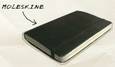
Moleskine—The PDA goes back to the future


Move over Palm Pilot and Pocket PC——the portable digital assistant for this season has gone retro and it's called the Moleskine (pronounced mol-a-skeen'-a). This little black book is the modern incarnation of the legendary notebook used by Van Gogh, Matisse, Breton, Picasso, Hemingway, Chatwin and now Conway.

Between its elegantly formed, hard black oilcloth covers rest 90 leaves, available blank, ruled or squared. Naturally, I chose the squared——why should order only be horizontal? There's also a neat expanding pocket in the rear, to house, I'm sure, the receipts from your favourite Parisian café. In it you'll find the history of the Moleskine, in French, German, Italian and (no doubt with some reluctance) English. There's a quality thread binding with bookmark, and a tasteful elastic closure to maintain discretion.

It's odd that something so quintessentially French should now be made in Italy, and predictably it comes at a premium——expect to pay about $22 Australian, £8 or $11 Stateside. But this is no mere notebook. It's an intimate connection with the creative current of history, a blank novel waiting to be written (just add words), a magnificent mythology. And as an entry ticket into the aspiring literati club, it would be cheap at thrice the price.

Most of all it's a beautiful anachronism, and the more I immerse myself in technology, the more I hanker for such things.

29 September 2004

Movie Review: Peter Sellers

I am usually the last one out of a movie theatre who isn’t being paid attendance money. Having a friend in the film-making business encourages me to pore over every word of the credits, savouring every funny name and future legend.

So it came as a surprise to see several groups still debating ‘Peter Sellers’ as I rose to my feet. They clearly were not discussing the merits of the film, as that, alas, would have been a fairly short topic of conversation. A little eavesdropping led me to the conclusion that they were instead discussing the accuracy of several aspects of the tale.

And let’s be clear, this is a tale, rather than a biographic film. It starts at the end of Sellers’ ‘Goon Show’ years, when I would really have like to see the background to how he came to be there, his relationships with Milligan, Seacombe et al. It then presents a theory of Sellers’ life which can be pretty well summarised in two sentences. I can just about picture it in my TV Guide now—“Peter Sellers was a flawed comic genius whose character was shaped by his domineering mother. He was therefore bereft of actual character, existing largely in a miasma of invented characters, both on and off screen, leading to a series of failed relationships, dependence on a charlatan psychic and his ultimate death from a dodgy ticker”.

Well, that’s a perfectly good theory, but it’s all a bit simple. One only has to look at Sellers’ improvisation in the Goons, Lolita or Strangelove to realise that he was a very rare sort of genius indeed, and I for one would rather have a wider picture of his life and come to my own conclusions, rather than have an interpretation of a man whom I have related to in film over many decades thrust upon me. In a sense this is a myopic biopic and manipulative to boot.

Sure, director Steve Hopkins tries to make the journey interesting. Reality and film sometimes blur into an attempt at stream of consciousness. Like a Sellers film, Geoffrey Rush moves in and out of Sellers various persona, and also those of key players in Sellers’ life. It’s a valiant attempt, but ultimately it’s all a bit to obvious and indelicate. To me, the artifice of a film should be like a skeleton—I want to know it’s there, but I’d rather not see it all the time.

What nearly saves this film is the performances. Geoffrey Rush is perfectly cast and shows real versatility, particularly in the excellent recreations of vignettes from Sellers’ films. He is ably supported by Emily Watson as first wife Anne, Sonia Aquino as Sophia Loren and Charlize Theron who is spot on as Britt Ekland and continues to grow in stature as an actress, as well as being pleasant to look at. John Lithgow overacts horribly as Blake Edwards, which makes him just about perfect from my recollection (what did Julie Andrews ever see in that man?) and Stephen Fry tries to play Oscar Wilde again, but in the wrong movie. Frankly the film would have been better (and shorter) without his character.

But even fine performances are not enough to make this a good film. It is ultimately too deliberate and too obviously manipulative for that. And the clever vignettes recreating actual Sellers’ films actually made me want to rush out of the theatre to borrow those Sellers originals rather than prolong the agony much longer. For a true Sellers fan this film will be disappointing, but one will have the satisfaction of the self-importance which comes through recognising many of the filmic references. For the person unfamiliar with Sellers’ work, it will hold no interest whatsoever. Whichever camp you are in, rush to your video store and demand a copy of Dr Strangelove. It will teach you much more about Sellers’ confused comic genius than any myopic biopic.