Hot on the heels of Nikon’s launch of the new D70S and D50 comes a firmware upgrade to the D70 which promises to raise the D70 to ‘S’ specification. The only features you’ll then be missing from the newer D70S are the slightly larger 2” LCD screen, and the ability to use a manual cable release. Huge kudos to Nikon for demonstrating such commitment to their user base.
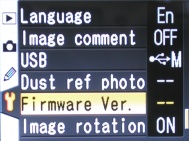 I upgraded my trustee D70 a few days ago. The process is simple enough. You just download the zip file from Nikon, format your CF card, copy file A over, insert the CF card in the cameras and navigate through the camera’s menus until you find the Firmware version option. When you select upgrade the camera thinks for a couple of minutes and it’s done. Same process for file B and you have a D70S (almost).
[Incidentally, I suggest downloading from the US site here (Windows) or here (Mac). The equivalent UK and Australian sites require form filling, registration and serial numbers. That’s just a pain.]
But what does it to do for you? Well the immediately obvious thing is the revised menus (as shown). They were pretty intuitive in the first place, but now they look great too. Gone is the boring old blue, to be replaced by a new grey feel with yellow highlights a little more 3-D effect if I’m not mistaken. There’s no doubt it looks a little more modern and is also easier to read, especially in bright light. It’s a minor improvement, but a hit with me.
Nikon claim that performance of the 5-area AF system has been improved in Dynamic area and Closest subject modes. That’s got to be a good thing, because closest subject mode has frustrated me no end, sometimes seeming completely random in its choice of subject. I have abandoned it in favour of Single area mode some time ago. Now I have my AE-L button set to lock exposure only and my camera always set to single area AF, so that a half-pressed shutter button locks focus. The only time I might step away from that is when snapping a rapidly moving object in which case Dynamic area comes to the fore. And my initial (very subjective) tests suggest that the focusing is now better in both these modes. A little faster and a little more accurate in its selection of focus area, but I’ll still be sticking to my existing setup 98% of the time.
Nikon have also upgraded the PictBridge functionality, allowing page-size settings to be applied from the camera. Well, whoop-di-do. I’ve already stated what I think of PictBridge, and won’t be changing my mind there in a hurry!
Also upgraded is the display of remaining exposures in NEF (aka RAW) mode which always was a little screwy and pessimistic. Better that than optimistic, but closer to correct is probably the best alternative, and I’d say it is much more accurate now, although I seldom use RAW mode myself.
The penultimate change is that the default setting for the camera clock has been changed from 2004.01.01 to 2005.01.01 and you can no longer set the clock back to a date before 2004.12.31. Yup, it’s true. My world is changed forever :-)
Lastly, Nikon claim that a bug has been fixed which “sometimes caused communication between the camera and computer to be unexpectedly terminated when using Nikon Capture Camera Control”. I’ll have to take their word for that, as I have never tried Camera Control. Has anyone else experienced this problem?
So all in all, there’s nothing earth-shattering in this upgrade (which suggests the same of the D70S, although I have yet to try one) but enough to make it worth the effort of doing. It will make your already great camera just that bit nicer to use and probably improve the second-hand resale value. The most significant thing about it is is probably the message it sends, that Nikon cares, and that can't be a bad thing.
> more articles on digicams





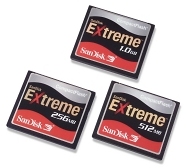 It's pushing 100°F in the Adelaide shade today. In nine days I'll be on a plane heading for Poland and I'm likely to see sub-zero temperatures. Those sort of temperature extremes take a toll on digital devices, and memory cards can be particularly vulnerable.
 VALUE:
 Along with laptop computers and cellphones, digital cameras are surely one of the most stolen 'personal accessories'. Cellphones have IMEI numbers, SIM card locks and passwords. Computers have operating system passwords and BIOS level protection, and biometric security devices such as fingerprint scanners are currently coming onto the market. Laptops and cellphones are still stolen in vast numbers, probably because thieves know that most owners don't use the security features available, but at least owners are being offered options.
 Digicam manufacturers all rave about how their latest cameras are 'PictBridge' enabled. Yup, you can print directly from your camera to your PB enabled printer without turning on your computer for a single solitary moment, not even a little bit. Sure my computer's on all the time anyway. Sure, I am completely opposed to plugging cables into my expensive digicam because once you stuff up the weedy little connectors your entire camera becomes a paperweight. PictBridge is really exciting technology, right?