
See more Technology Videos at Today's Big Thing.
Showing posts with label observations. Show all posts
Showing posts with label observations. Show all posts
16 March 2009
The Onion comments on Sony--hilarious but with language alert
The Onion comments on Sony and technology in general. Be warned, there is language in this clip of the sort not usually seen or heard on eebahgum!


Sony's misleading advertising 2
Yup, there's more from our friends at Sony. It's the impossibly thin LCD TV which isn't as thin as they say it is. "Be the first to be seen," says Sony, "with the new ZX1". It's as thin as a CD case at 9.9 mm! But wait, there's an asterisk and it goes ... let's see, down to the bottom of the ad ... oh, here it is: "At its slimmest part". So it's not 9.9 mm thin then. My house is 1 brick thick* (at its thinnest part, the bricks that protrude from my window sills). My car is 10 cm high* (*at the front bumper). I don't have a pot belly* (*when lying down).
The picture below clearly show that more than 2/3 of this new TV is not 9.9 mm thick. Sure the LCD panel itself is that thin, due to the clever side rather than back illumination, but you can't just watch an LCD panel. It's got to have those, you know, TV bits and stuff to make a TV--power supply, tuner, etc. Sony have actually made all those things impressively thin, so the whole TV (minus stand or speakers) is actually only abut three times as deep as the screen. Wouldn't it be just as impressive to tell the truth and advertise the set as "an amazing 3 cm thick, and no asterisks required!" But once again, Sony's marketing department chooses to mask the very real cleverness of their R&D people with a downright, dare I say it, LIE! And the media are picking this up as if it were gospel, though most of the reports, even on tech-savvy sites such as gizmodo, uncritically omit the asterisk and accompanying phrase. Shame, shame, shame, as Australian media character Derryn Hinch used to say.

The picture below clearly show that more than 2/3 of this new TV is not 9.9 mm thick. Sure the LCD panel itself is that thin, due to the clever side rather than back illumination, but you can't just watch an LCD panel. It's got to have those, you know, TV bits and stuff to make a TV--power supply, tuner, etc. Sony have actually made all those things impressively thin, so the whole TV (minus stand or speakers) is actually only abut three times as deep as the screen. Wouldn't it be just as impressive to tell the truth and advertise the set as "an amazing 3 cm thick, and no asterisks required!" But once again, Sony's marketing department chooses to mask the very real cleverness of their R&D people with a downright, dare I say it, LIE! And the media are picking this up as if it were gospel, though most of the reports, even on tech-savvy sites such as gizmodo, uncritically omit the asterisk and accompanying phrase. Shame, shame, shame, as Australian media character Derryn Hinch used to say.
12 March 2009
Sony's misleading advertising 1
The new Sony Bravia LCD TVs boast 200Hz Motionflow technology and claim to have "the smoothest picture ever". Unfortunately, some of the explanations given for the technology are simplistic, or just downright misleading. They show pictures of a footballer with added frames, and have a little video on their website showing a flickbook with lots of frames looking smoother than one with fewer frames. All very convicing, and well, wrong.
The bottom line is the broadcast signal you are watching was only recorded at up to 50 Hz to 60 Hz or fields per second. That's all the information there is. There's nothing between those frames and no amount of post processing by the TV after the event will change that. What the Sony sets (and others) are doing is looking at two of those frames and making up other frames in between them by averaging the two actual frames. They're not real frames, so these sets aren't really giving you 200 Hz, they're just interpolating between the actual frames to smooth the transition that the eye sees.
Now if you look closely at the deepest explanation that Sony gives, you'll see them describe that interpolation process accurately enough. They say "the sharpness of each image frame is boosted by Image Blur Reduction before its contents are analysed and three 'in between' frames are added between it and the next frame. This spreads two frames worth of motion across five frames". So far so good until they conclude "so effectively 50 frames per second becomes 200". No, sorry, that's wrong. These are made up frames. It is not at all the same as a genuine 200 Hz frame rate and neither does it look it.
So even Sony's most detailed explanation has been hijacked by the marketing boys and made into an untruth. But of course, the evils of marketing don't stop there. Most explanations aren't even that detailed, and as the ideas become more and more like sound-bytes, so any attempts at accuracy become the first casualties.
This kind of deception is pretty inexcusable, not only because it's playing fast and loose with the truth but also, and perhaps worse, because it insults the consumer. It attempts to reduce the issue to a 'numbers game' at point of sale and as such it's deliberately aimed at the consumer who doesn't know better. Rather than educate, it's an attempt to befuddle with meaningless numbers, rather like the battle for megapixels in digital cameras.
But the good news is, this technology does actually improve the picture. Sony's new 200Hz-interpolated sets do have the smoothest motion I've seen on an LCD. Is it the smoothest picture ever? No, because a good plasma set still looks better by a reasonable margin to my eye, but these Sonys are the first LCD sets I might be convinced to watch sport on.
The bottom line is the broadcast signal you are watching was only recorded at up to 50 Hz to 60 Hz or fields per second. That's all the information there is. There's nothing between those frames and no amount of post processing by the TV after the event will change that. What the Sony sets (and others) are doing is looking at two of those frames and making up other frames in between them by averaging the two actual frames. They're not real frames, so these sets aren't really giving you 200 Hz, they're just interpolating between the actual frames to smooth the transition that the eye sees.
Now if you look closely at the deepest explanation that Sony gives, you'll see them describe that interpolation process accurately enough. They say "the sharpness of each image frame is boosted by Image Blur Reduction before its contents are analysed and three 'in between' frames are added between it and the next frame. This spreads two frames worth of motion across five frames". So far so good until they conclude "so effectively 50 frames per second becomes 200". No, sorry, that's wrong. These are made up frames. It is not at all the same as a genuine 200 Hz frame rate and neither does it look it.
So even Sony's most detailed explanation has been hijacked by the marketing boys and made into an untruth. But of course, the evils of marketing don't stop there. Most explanations aren't even that detailed, and as the ideas become more and more like sound-bytes, so any attempts at accuracy become the first casualties.
This kind of deception is pretty inexcusable, not only because it's playing fast and loose with the truth but also, and perhaps worse, because it insults the consumer. It attempts to reduce the issue to a 'numbers game' at point of sale and as such it's deliberately aimed at the consumer who doesn't know better. Rather than educate, it's an attempt to befuddle with meaningless numbers, rather like the battle for megapixels in digital cameras.
But the good news is, this technology does actually improve the picture. Sony's new 200Hz-interpolated sets do have the smoothest motion I've seen on an LCD. Is it the smoothest picture ever? No, because a good plasma set still looks better by a reasonable margin to my eye, but these Sonys are the first LCD sets I might be convinced to watch sport on.
1 August 2008
Never bond with chickens
Late last year, junior brought home two chicks that had been incubated as a class experiment, and they grew into chickens in the backyard. They were extremely free-range, wandering the garden by day and sleeping in a tree by night. I started building a coop, but didn't persevere as they seemed content in the treetops and I am naturally poor at finishing things around the home that I start.
One of the chickens, an Ancona, was a capable flyer and displayed mind-boggling intelligence on several occasions, then crowned off the display of intelligence by escaping a few weeks ago never to be seen again. The other, a New Hampshire Red, stayed and, whilst not as bright, was nevertheless a friendly, almost affectionate bird with whom we have been bonding over the last several weeks.
But all that came to an end this morning when I found her brutally decapitated and distributed over the back lawn. Despite my creating sheltered accomodation for her in her tree, she still insisted on sheltering and laying at ground level, and something had found her there overnight and attacked her. Might have been a fox, but more likely a cat. A rather gruesome and depressing sight in itself, but also one that reminded me of the perils of bonding with animals. We're always told of the positive mental health outcomes of pets and animals, but like many people I create very strong attachments to creatures feline or feathered, and find myself inordinately affected by their loss and often guilt-ridden as a result of the things I might have done to prevent that loss.
Over many years of caring for pets, for one doesn't really 'own' them, I have had responsibility for couple of cats, a guinuea pig, a turtle, a rat, several fish and birds aplenty, including budgies, galahs, parakeets, African Grey parrots and a cockatiel. I remember each one fondly, but in each case was deeply impacted upon by their demise/loss/escape. Am I one of that plethora of people who bond with animals to avoid bonding with humans, or was Gandhi right when he said "The greatness of a nation and its moral progress can be judged by the way its animals are treated"?
One of the chickens, an Ancona, was a capable flyer and displayed mind-boggling intelligence on several occasions, then crowned off the display of intelligence by escaping a few weeks ago never to be seen again. The other, a New Hampshire Red, stayed and, whilst not as bright, was nevertheless a friendly, almost affectionate bird with whom we have been bonding over the last several weeks.
But all that came to an end this morning when I found her brutally decapitated and distributed over the back lawn. Despite my creating sheltered accomodation for her in her tree, she still insisted on sheltering and laying at ground level, and something had found her there overnight and attacked her. Might have been a fox, but more likely a cat. A rather gruesome and depressing sight in itself, but also one that reminded me of the perils of bonding with animals. We're always told of the positive mental health outcomes of pets and animals, but like many people I create very strong attachments to creatures feline or feathered, and find myself inordinately affected by their loss and often guilt-ridden as a result of the things I might have done to prevent that loss.
Over many years of caring for pets, for one doesn't really 'own' them, I have had responsibility for couple of cats, a guinuea pig, a turtle, a rat, several fish and birds aplenty, including budgies, galahs, parakeets, African Grey parrots and a cockatiel. I remember each one fondly, but in each case was deeply impacted upon by their demise/loss/escape. Am I one of that plethora of people who bond with animals to avoid bonding with humans, or was Gandhi right when he said "The greatness of a nation and its moral progress can be judged by the way its animals are treated"?
31 July 2008
Democracy at work?
The South Australian Government has just changed its mind about its approach to the aspects of health care for rural issues in response to public sentiment over the issue. It's described in the local rag as "an embarassing backflip", but surely improving policy in response to public opinion is simply effective democracy at work, and governments admitting they may have erred shows a rare humility and self-effacement that should be lauded rather than condemned.
13 September 2007
Why isn't 'dipslay' in the dictionary?
Come now, Messrs Oxford, Webster, Collins et al. Why isn't the word 'dipslay' in your dictionaries? Anyone who has worked as a tech writer would be extremely familiar with this commonly used word. And although it's not to be found in dictionaries, almost everyone would know what it means. I have often used the word in conversation with other tech writer friends, appreciating its clumsy yet beguiling naivety. I'm clearly not the only one, as a quick Google search shows 18,000 occurrences of the word on the web, despite the fact that spell-checkers tend to insidiously target it.
So how can you have a word added to a dictionary? Unfortunately you can't just send it in to Merriam-Webster and have them list it. To quote from their website FAQ:
...the selection of which words to include in the dictionary is not based on personal preferences or popularity-contest-style votes; it is based on usage. Simply put, to gain entry to the dictionary, a word must be widely used in a broad range of professionally written and edited materials over an extended period of time. Any word that has sufficiently widespread use in such publications is eligible for dictionary entry.
On that basis, dipslay is surely a shoe-in. It occurs in a gazillion professionally written and edited manuals, several of them, no doubt, written and edited by me.
So, esteemed fellow travellers in the blogosphere, let's help raise dipslay to its rightful place in the dictionaries by using it as often as possible. Perhaps it can become the first typo officially recognised as a word in its own right, a title it surely deserves more than the much more commonplace but rather vulgar 'teh'.

So how can you have a word added to a dictionary? Unfortunately you can't just send it in to Merriam-Webster and have them list it. To quote from their website FAQ:
...the selection of which words to include in the dictionary is not based on personal preferences or popularity-contest-style votes; it is based on usage. Simply put, to gain entry to the dictionary, a word must be widely used in a broad range of professionally written and edited materials over an extended period of time. Any word that has sufficiently widespread use in such publications is eligible for dictionary entry.
On that basis, dipslay is surely a shoe-in. It occurs in a gazillion professionally written and edited manuals, several of them, no doubt, written and edited by me.
So, esteemed fellow travellers in the blogosphere, let's help raise dipslay to its rightful place in the dictionaries by using it as often as possible. Perhaps it can become the first typo officially recognised as a word in its own right, a title it surely deserves more than the much more commonplace but rather vulgar 'teh'.
18 July 2007
Desperate Australian Government resorts to terrorism card in last-ditch attempt to hold power
It’s a well-known truism of politics that if the people are unsettled or insecure they tend not to change governments. It has worked for Australia’s Howard Government in the past, when they deliberately played up ludicrous stories of babies being thrown overboard by refugees (whom they’d rather label as illegal immigrants or potential terrorists from the outset), and bought into the ‘weapons of mass destruction’ fiasco. Now, with the polls against them in an election year, they’ve decided to once again try and scare us with the terrorism threat.
For those of you not familiar with the saga let me give my 25-word (-ish) summary. Unexploded bombs discovered in London/associated terrorism suspect found with borrowed SIM card/SIM card traced back to Indian (Muslim) doctor Mohammed Haneef in Queensland hospital/doctor held for some time without details of actual offence being revealed to public, then finally charged with “recklessly providing resources to a terrorist organisation”/Federal Immigration Minister undermines court process by talking a great deal about the case, and whilst revealing no substantive facts regularly hints at secret info he has that makes it clear the man is of unfit character/Magistrate’s Court grants him bail pending hearing, clearly believing that he’s not much of a threat/Minister decides that he will be locked up in immigration detention anyway and his visa suspended until he can be expelled.
Now maybe this fella was up to no good, or at least knew people who were, but there was I labouring under the misapprehension that we had some sort of rule of law in this country. Instead I find the government can overrule that, as well as taking punitive action against someone on the basis of as yet unproven allegations. And whilst this evil-SIM-card-lending-threat-to-all-we-hold-sacred is to be detained and exported, the Australian Wheat Board’s A$300 million bribery scandal in Iraq seemed to pass gently by with no heads being patted, let alone rolled.
The Immigration Minister, Kevin Andrews, suggests that he is "acting in the national interest and about matters that go to national security". But far from making us feel safer, this should make all Australians feel very, very insecure indeed. This is the same government which completely failed to assist its own citizens detained overseas for years on beat-up charges in luxury accommodation in Guantanamo Bay and committed to military action in Iraq on beat-up allegations. ‘Be Alert not Alarmed’, they beseech us, whilst trying their utmost at every turn to terrify the populace by inventing new reds to place under our beds.
The Howard Government's history is already a shameful litany of lies and cover-ups, any one of which should have appalled the Australian people enough to kick them out years ago. And although these things have undoubtedly damaged our international reputation, they’ve generally buoyed the government’s political fortunes at home. But the credulity of the Australian people seems finally to be wearing thin, and I believe, and earnestly hope, that the government’s handling of the Haneef affair will be seen for the politically motivated, self-serving action that it is, and ultimately the final nail this government’s coffin.
For those of you not familiar with the saga let me give my 25-word (-ish) summary. Unexploded bombs discovered in London/associated terrorism suspect found with borrowed SIM card/SIM card traced back to Indian (Muslim) doctor Mohammed Haneef in Queensland hospital/doctor held for some time without details of actual offence being revealed to public, then finally charged with “recklessly providing resources to a terrorist organisation”/Federal Immigration Minister undermines court process by talking a great deal about the case, and whilst revealing no substantive facts regularly hints at secret info he has that makes it clear the man is of unfit character/Magistrate’s Court grants him bail pending hearing, clearly believing that he’s not much of a threat/Minister decides that he will be locked up in immigration detention anyway and his visa suspended until he can be expelled.
Now maybe this fella was up to no good, or at least knew people who were, but there was I labouring under the misapprehension that we had some sort of rule of law in this country. Instead I find the government can overrule that, as well as taking punitive action against someone on the basis of as yet unproven allegations. And whilst this evil-SIM-card-lending-threat-to-all-we-hold-sacred is to be detained and exported, the Australian Wheat Board’s A$300 million bribery scandal in Iraq seemed to pass gently by with no heads being patted, let alone rolled.
The Immigration Minister, Kevin Andrews, suggests that he is "acting in the national interest and about matters that go to national security". But far from making us feel safer, this should make all Australians feel very, very insecure indeed. This is the same government which completely failed to assist its own citizens detained overseas for years on beat-up charges in luxury accommodation in Guantanamo Bay and committed to military action in Iraq on beat-up allegations. ‘Be Alert not Alarmed’, they beseech us, whilst trying their utmost at every turn to terrify the populace by inventing new reds to place under our beds.
The Howard Government's history is already a shameful litany of lies and cover-ups, any one of which should have appalled the Australian people enough to kick them out years ago. And although these things have undoubtedly damaged our international reputation, they’ve generally buoyed the government’s political fortunes at home. But the credulity of the Australian people seems finally to be wearing thin, and I believe, and earnestly hope, that the government’s handling of the Haneef affair will be seen for the politically motivated, self-serving action that it is, and ultimately the final nail this government’s coffin.
10 July 2007
Deal with eBay negativity using Toolhaus and Firefox
Following on from my previous post about ebay negatives, let me introduce Toolhaus—my favourite tool as a buyer on eBay. Just type in the name of a seller and it shows all their negative/neutral and withdrawn feedback, uninterrupted by those pesky positives. This, as Bowie would say, is the Nazz!
Just look how it seems to polarise eBayers. Some (most) seem to love it, but you get comments such as “That site is HORRIBLE and a disservice to EBay users. I understand the intention but it is very dangerous and produce (sic) more harm than good”, “I hate that toolhaus thing. Lame. “ and “That site is digusting (sic), what is it, lets find the bad side of sellers and exploit it”. Hey, anything that “digusting” must surely have merit!
 And there’s a little plug in for Firefox that makes Toolhaus even easier to use by adding quick access to the tool to your right click menu. Just point at a seller’s eBay id, right click and Bob’s your auntie’s grandmother’s poodle. If you are using Firefox, and of course you are, download it here.
Just look how it seems to polarise eBayers. Some (most) seem to love it, but you get comments such as “That site is HORRIBLE and a disservice to EBay users. I understand the intention but it is very dangerous and produce (sic) more harm than good”, “I hate that toolhaus thing. Lame. “ and “That site is digusting (sic), what is it, lets find the bad side of sellers and exploit it”. Hey, anything that “digusting” must surely have merit!
And there’s a little plug in for Firefox that makes Toolhaus even easier to use by adding quick access to the tool to your right click menu. Just point at a seller’s eBay id, right click and Bob’s your auntie’s grandmother’s poodle. If you are using Firefox, and of course you are, download it here.
Ebay feedback—reading between the lines
Newbies to eBay are often misled into putting too much faith in eBay feedback numbers. On the surface 99% seems like a high number, but in reality could be telling a very different story, particularly if the seller is moving high volumes.
So my advice to eBay newbies is to forget about the percentage and look instead at the number of negative/neutral and withdrawn feedbacks and their nature. For example, I came across a seller the other day who had a feedback rating of 98.8% based on 3,500 transactions. This tells me that there were a lot of people who were not impressed, in fact 43 negatives, more than 60 neutrals and dozens of withdrawns. And when I looked through the comments, I noticed significant patterns, falling into the three or four usual groups. People were complaining about slow despatch, receiving the wrong items or items in bad condition, excessive postal charges and items being despatched from Hong Kong though advertised from the UK.
Now, I like to give people the benefit of the doubt, and even the most conscientious seller can make honest mistakes from time to time, so I do not expect sellers to have 100% feedback. But when you get the same feedback for the same problems over and over, you are a seller to be avoided. In the case of my example seller, it was clear that he was breaking a number of eBay rules. He was a Hong Kong seller who was pretending to be based in the UK; he was lowering the buy price and padding out the P&P unreasonably, a favourite trick of Hong Kong sellers; and he was selling stock he didn’t actually have. He was also selling some crappy product, but that, alas, is not against eBay rules. Caveat emptor, as always.
Interestingly, this seller’s answer to disgruntled buyers was always to try and discredit the buyer. “Another deadbeat buyer” he would opine repeatedly, or he would defend his excessive padding of P&P by encouraging buyers to look at the overall cost. Of course, that’s not bad advice in itself, but it’s still against eBay rules to sell an item that is clearly worth $300 for $0.99 plus $299 in postage. But his most amusing defence was to say “If this were true... why would we have such good feedback?” Er, I’m looking at your feedback, mate, and all I see is 150 or so very annoyed customers.
Of course, 98.8% of buyers are apparently happy with this seller, who is certainly not an extreme case as eBay sellers go—many are far worse. But even that positive feedback is misleading because most sellers refuse to leave feedback until the buyer has done so. This is, effectively, a form of blackmail. In fact the buyer has fulfilled his contractual obligation in an eBay transaction as soon as payment is received by the seller, and it’s at this point that sellers should leave feedback, as, indeed, a few of them do. Hats off to those people, but eBay should build this into its system and force sellers to leave feedback first, in my opinion.
Ebay has recently introduced the option for buyers to leave detailed feedback on four aspects of a transaction: item description, seller’s communications, speed of posting and postage and packaging cost. Whilst the overall feedback is visible to the seller, this detailed breakdown is not, so you could theoretically avoid a bad seller blackmailing you by leaving positive overall feedback and then very poor detailed feedback. It’s a major improvement, and will work very well if buyers use 4/5 stars as the benchmark for a good transaction and only award the fifth star in exceptional cases. I think ebay is to be commended for this initiative, but I’d still like to see sellers forced to leave feedback as soon as payment is received.
In my experience, the vast majority of the sellers I have dealt with have been honest and remarkably efficient, and I am constantly amazed by how many people seem to live at the Post Office, ready to despatch my orders the nanosecond I press the Buy button. Reading between the lines of eBay feedback will help you identify these people before you buy and avoid the others.
In my next post I’ll point you towards a great tool for analysing negative and neutral feedback. Watch this space :-)
So my advice to eBay newbies is to forget about the percentage and look instead at the number of negative/neutral and withdrawn feedbacks and their nature. For example, I came across a seller the other day who had a feedback rating of 98.8% based on 3,500 transactions. This tells me that there were a lot of people who were not impressed, in fact 43 negatives, more than 60 neutrals and dozens of withdrawns. And when I looked through the comments, I noticed significant patterns, falling into the three or four usual groups. People were complaining about slow despatch, receiving the wrong items or items in bad condition, excessive postal charges and items being despatched from Hong Kong though advertised from the UK.
Now, I like to give people the benefit of the doubt, and even the most conscientious seller can make honest mistakes from time to time, so I do not expect sellers to have 100% feedback. But when you get the same feedback for the same problems over and over, you are a seller to be avoided. In the case of my example seller, it was clear that he was breaking a number of eBay rules. He was a Hong Kong seller who was pretending to be based in the UK; he was lowering the buy price and padding out the P&P unreasonably, a favourite trick of Hong Kong sellers; and he was selling stock he didn’t actually have. He was also selling some crappy product, but that, alas, is not against eBay rules. Caveat emptor, as always.
Interestingly, this seller’s answer to disgruntled buyers was always to try and discredit the buyer. “Another deadbeat buyer” he would opine repeatedly, or he would defend his excessive padding of P&P by encouraging buyers to look at the overall cost. Of course, that’s not bad advice in itself, but it’s still against eBay rules to sell an item that is clearly worth $300 for $0.99 plus $299 in postage. But his most amusing defence was to say “If this were true... why would we have such good feedback?” Er, I’m looking at your feedback, mate, and all I see is 150 or so very annoyed customers.
Of course, 98.8% of buyers are apparently happy with this seller, who is certainly not an extreme case as eBay sellers go—many are far worse. But even that positive feedback is misleading because most sellers refuse to leave feedback until the buyer has done so. This is, effectively, a form of blackmail. In fact the buyer has fulfilled his contractual obligation in an eBay transaction as soon as payment is received by the seller, and it’s at this point that sellers should leave feedback, as, indeed, a few of them do. Hats off to those people, but eBay should build this into its system and force sellers to leave feedback first, in my opinion.
Ebay has recently introduced the option for buyers to leave detailed feedback on four aspects of a transaction: item description, seller’s communications, speed of posting and postage and packaging cost. Whilst the overall feedback is visible to the seller, this detailed breakdown is not, so you could theoretically avoid a bad seller blackmailing you by leaving positive overall feedback and then very poor detailed feedback. It’s a major improvement, and will work very well if buyers use 4/5 stars as the benchmark for a good transaction and only award the fifth star in exceptional cases. I think ebay is to be commended for this initiative, but I’d still like to see sellers forced to leave feedback as soon as payment is received.
In my experience, the vast majority of the sellers I have dealt with have been honest and remarkably efficient, and I am constantly amazed by how many people seem to live at the Post Office, ready to despatch my orders the nanosecond I press the Buy button. Reading between the lines of eBay feedback will help you identify these people before you buy and avoid the others.
In my next post I’ll point you towards a great tool for analysing negative and neutral feedback. Watch this space :-)
1 May 2007
Escalator Etiquette
Mahatma Gandhi suggested that you could tell a lot about a society from the way it used escalators. That's a slight paraphrasal—I think his original statement mentioned animals rather that escalators, but the idea, I'm sure you'll agree, remains the same.
By that criteria, my hometown of Adelaide is in a sorry state. Unlike London, or Sydney, or any other major city in the civilised world, people do not stand to one side to allow faster moving traffic clear thoroughfare. Instead, they just stand there like zombies on a day trip to the big smoke. And unlike many cities, there are no helpful signs here to dissuade people from this behaviour.
Surely this is a little thing, I hear you say. You may well be right, but because I have little else to gripe about today, I prefer to see it as emphatic evidence of a far deeper societal malaise. Have these people no manners or common sense? Are they utterly oblivious to the needs of others and to the world about them? Is it selfishness, lack of education, drugs or just simple stupidity?
And is this an Adelaide thing, or does it happen in your city too? Ben Harris at Metroblogging Bangkok bemoans the cummulative time lost in his life waiting for people while they prepare to mount escalators. What is your escalator experience?
By that criteria, my hometown of Adelaide is in a sorry state. Unlike London, or Sydney, or any other major city in the civilised world, people do not stand to one side to allow faster moving traffic clear thoroughfare. Instead, they just stand there like zombies on a day trip to the big smoke. And unlike many cities, there are no helpful signs here to dissuade people from this behaviour.
Surely this is a little thing, I hear you say. You may well be right, but because I have little else to gripe about today, I prefer to see it as emphatic evidence of a far deeper societal malaise. Have these people no manners or common sense? Are they utterly oblivious to the needs of others and to the world about them? Is it selfishness, lack of education, drugs or just simple stupidity?
And is this an Adelaide thing, or does it happen in your city too? Ben Harris at Metroblogging Bangkok bemoans the cummulative time lost in his life waiting for people while they prepare to mount escalators. What is your escalator experience?
7 April 2007
No thanks, I already have one
The premises of an old brothel in Adelaide have recently gone on sale. According to the estate agent, they’re a good buy at around A$2 million. For that you get a small 5-story building with a penthouse flat, swimming pool and spa, not to mention a whole lot of history.
The local paper, that bastion of social conscience and erudite insight, The Advertiser, has a daily Vox Pop in which they asked passers-by whether they would consider buying a former brothel. One of the respondents said that, although she did invest in property, she would not buy this one because she was “looking to diversify her portfolio”. I guess you can only have so many of a good thing.
The local paper, that bastion of social conscience and erudite insight, The Advertiser, has a daily Vox Pop in which they asked passers-by whether they would consider buying a former brothel. One of the respondents said that, although she did invest in property, she would not buy this one because she was “looking to diversify her portfolio”. I guess you can only have so many of a good thing.
2 February 2007
iRudeness
Hello, Ned Ludd here.
Almost 20 years ago I remember bumping into a close acquaintance at the university library. We had a brief 'how's uni' conversation, during which time he asked me several questions, and affirmed my responses with the odd "Right", "I see" and "That's great". As we wound up and he turned away I realised by the wire emanating from his left ear that he was wired for sound and probably hadn't heard a single word I said.
That was near the beginning of the portable music revolution, when we revelled in a technology known as the audio cassette, which many of today's mp3meisters have never even seen. Different time, then, but same issues--yet another nail in the coffin of civility and social interaction. Today I lined up at the local supermarket and both the shoppers in front of me were chained to their ipods. The first at least offered some grunt of acknowledgement to the checkout operator, the second was too immersed in the metronomic pounding in his ear drums to even be that gracious. In other public places such as trains and fast-food joints, basic civilities like after yous, pleases and excuse mes are passing into oblivion as increasing numbers of people have their ears shut off to the outside world, and their minds soon follow.
Whilst I am a technology junkie, I cannot understand how this can possibly be seen as progress. Let's catch it whilst it's still a trend and before it becomes normal. Let's reinforce the notion that it is simply rude to be wearing headphones whilst talking to people, and even when in a public situation where incidental conversation might occur. I know that many communications courses teach people to talk less and listen more, but I think they mean 'to each other'!
Almost 20 years ago I remember bumping into a close acquaintance at the university library. We had a brief 'how's uni' conversation, during which time he asked me several questions, and affirmed my responses with the odd "Right", "I see" and "That's great". As we wound up and he turned away I realised by the wire emanating from his left ear that he was wired for sound and probably hadn't heard a single word I said.
That was near the beginning of the portable music revolution, when we revelled in a technology known as the audio cassette, which many of today's mp3meisters have never even seen. Different time, then, but same issues--yet another nail in the coffin of civility and social interaction. Today I lined up at the local supermarket and both the shoppers in front of me were chained to their ipods. The first at least offered some grunt of acknowledgement to the checkout operator, the second was too immersed in the metronomic pounding in his ear drums to even be that gracious. In other public places such as trains and fast-food joints, basic civilities like after yous, pleases and excuse mes are passing into oblivion as increasing numbers of people have their ears shut off to the outside world, and their minds soon follow.
Whilst I am a technology junkie, I cannot understand how this can possibly be seen as progress. Let's catch it whilst it's still a trend and before it becomes normal. Let's reinforce the notion that it is simply rude to be wearing headphones whilst talking to people, and even when in a public situation where incidental conversation might occur. I know that many communications courses teach people to talk less and listen more, but I think they mean 'to each other'!
26 December 2006
Tom Baker Says...
Here's perhaps the silliest site I have come across this silly season.
BT sat down Tom Baker, that greatest of all Dr Whos and now the narrator of Little Britain, in front of a microphone with a dictionary to record phrases. 11,593 of them, to be precise. They're then broken down and reassembled to make other sentences of various sorts, mostly a little rude, sometimes witty, always downright silly.
For a while Tom's voice was actually used by BT as the voice on their text messaging service, but alas, that is no longer. But we still have Tom Baker Says. Check it out:
Tom Baker Says...
BT sat down Tom Baker, that greatest of all Dr Whos and now the narrator of Little Britain, in front of a microphone with a dictionary to record phrases. 11,593 of them, to be precise. They're then broken down and reassembled to make other sentences of various sorts, mostly a little rude, sometimes witty, always downright silly.
For a while Tom's voice was actually used by BT as the voice on their text messaging service, but alas, that is no longer. But we still have Tom Baker Says. Check it out:
Tom Baker Says...
25 December 2006
Strange thoughts on train
As one who so enjoys driving, I find my morning train commutes into the city of Adelaide to be journeys of continual revelation. A car, at least for most men, is so much an expression of the self and a buffer against the world that would intrude upon that self. The initial choice of model, colour, accessories; the music or radio shows in which you envelope yourself; even perhaps the routes you chose are, in some small way, about control, self-expression, the ego.
By contrast, trains gently force you to relinquish control, and to interact with the world and others in that curious, usually wordless way that is unique to rail transport. I often reflect on the fact that a train contains a vast collection of untold stories. Its like a massive bookshop containing only new releases by as yet unheard of writers. As you share a journey with these writers you get to know just a little about them by what they read, the way they dress, walk, browse the other passengers and how they converse with their companions. It's like reading the dust covers in the bookshop.
Often you see the same people on a daily basis and suddenly you seem to be in a relationship. I passed a man in the street the other day whom I recognised as a fellow rail traveller. We acknowledged each other shortly but with more than a hint of warmth because we shared a previous connection in a place where we would both otherwise have been disconnected from everyone.
And at the end of the day, these tiny connections are the lifeblood of existence. The hankering for connectedness of any sort is one of the major drivers for most people; the lack of that connectedness the principle cause of sadness.
On the morning journey, staring out of one of the scratched and hazy expanses of Perspex which pass for windows on South Australian trains and listening to Laurie Anderson's 'Big Science' on mp3, I was suddenly a little overwhelmed by this unextraordinary moment and wished my son were there to share it with me. Perhaps that too is inherent in human nature--through connection with others we can turn ordinary experiences into something more. But then it occurred to me that even of he were there, we would not be sharing my experience, but sharing a moment in which we were having different experiences. Those moments in life in which you look at someone else and have a deep sense that your experience or thoughts have genuinely aligned are extremely rare, and beyond price.
By contrast, trains gently force you to relinquish control, and to interact with the world and others in that curious, usually wordless way that is unique to rail transport. I often reflect on the fact that a train contains a vast collection of untold stories. Its like a massive bookshop containing only new releases by as yet unheard of writers. As you share a journey with these writers you get to know just a little about them by what they read, the way they dress, walk, browse the other passengers and how they converse with their companions. It's like reading the dust covers in the bookshop.
Often you see the same people on a daily basis and suddenly you seem to be in a relationship. I passed a man in the street the other day whom I recognised as a fellow rail traveller. We acknowledged each other shortly but with more than a hint of warmth because we shared a previous connection in a place where we would both otherwise have been disconnected from everyone.
And at the end of the day, these tiny connections are the lifeblood of existence. The hankering for connectedness of any sort is one of the major drivers for most people; the lack of that connectedness the principle cause of sadness.
On the morning journey, staring out of one of the scratched and hazy expanses of Perspex which pass for windows on South Australian trains and listening to Laurie Anderson's 'Big Science' on mp3, I was suddenly a little overwhelmed by this unextraordinary moment and wished my son were there to share it with me. Perhaps that too is inherent in human nature--through connection with others we can turn ordinary experiences into something more. But then it occurred to me that even of he were there, we would not be sharing my experience, but sharing a moment in which we were having different experiences. Those moments in life in which you look at someone else and have a deep sense that your experience or thoughts have genuinely aligned are extremely rare, and beyond price.
18 July 2006
Happy Birthday, Clive
No, it's not my birthday, but that's less than three months away, so feel free to start saving now. However, there is another Clive on the other side of the world who is celebrating his birthday today. I don't know his surname or anyting else about him, only that on this day last year my friend Sebastian and I were in the Cinque Port town of Sandwich in Kent, and came across this sign attached at the base of another sign:
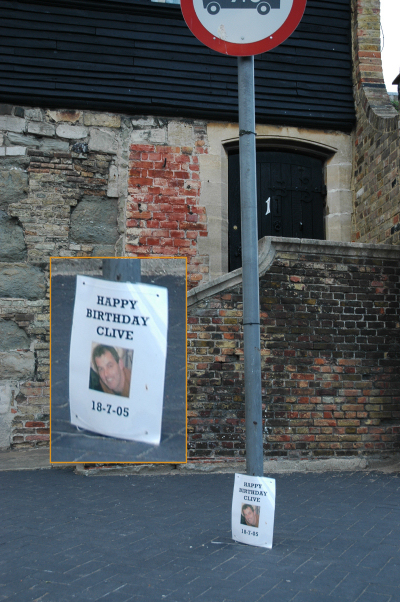
Purely by accident, I happened to find this picture today and noticed it's exactly a year on. So Happpy Birthday, Clive, whoever and wherever you are!
19 February 2006
Shimano bike components are a joke!
Once upon a time I was a serious cyclist. That was before the fractured kneecap, inflamed plicas, pot belly and so on. And 20 years ago I acquired a couple of top of the line bicycles. My road bike was the bee’s knees—hand built Reynolds 531 SL frame, Campagnolo Super Record Groupset and Suntour Superbe brakes. It was sold to a happy owner long ago. Still in my possession is my time trial bike, a Kettler, handmade in Germany from very early aluminium teardrop tubing and fully equipped with top-of-the-line Shimano aerodynamic gear. Because I used this bike only against the clock I stripped off every unnecessary part, including most of the cogs, so it now has 2 front cogs and a rear cluster of only 3. Low gears not necessary when sprinting or when young.
So after a break of more than a dozen years from cycling I’ve decided to take it up again to accompany my 9 year old on his flash new aluminium framed Giant. And unsurprisingly, there are a few parts on my bike which could use a refresh. Most notably, the rubber brake hoods are withered, the brake cables are rather stiff and the shoes seem to have hardened up. So down to the bike shop I go to get a few replacement parts, only to discover that Shimano stop making them after 5 years or so. The mechanisms may be in perfect working order, but as far as Shimano are concerned, you need to buy new ones. Even the brake shoes are not replaceable any more. That’s great customer support, eh? Compare that with Campagnolo, Italy’s major component manufacturer. I have an old track bike I bought as a novelty item. It’s in lovely condition but is about 50 years old. Even so, spare parts are still available because it’s equipped with Campagnolo Record components.
Problem is, when you walk into a bike shop, almost every bike is equipped with Shimano components. And they look very trendy and beguiling to the unwary, but you won’t catch me buying them again.
And speaking of Bike Shops, I went into Super Elliots in Adelaide today, and was greeted by some of the most arrogant service I have ever seen. I asked about rubber brake lever covers, and the young bloke scoffs at me and says “That bike’s older than I am.” Yes mate, so am I, but I bet both my bike and I work better than you do. He then suggests I just buy replacement levers for $20, and shows me some for $60, so clearly numbers were not his forte either. Then he just looks dismissive and grunts “Just buy a new bike, mate”. I told him about Campagnolo and spare parts, and he went into a great diatribe about how out-of-date they were, and how great Shimano gear is. That must be why top line racing bikes use Campagnolo, then. I can see why bike shops like Shimano though—all their customers have to buy new bikes after 5 or 10 years when all they need is a set of brake shoes or rubber hoods.
So a great big raspberry to Super Elliots and Shimano.
So after a break of more than a dozen years from cycling I’ve decided to take it up again to accompany my 9 year old on his flash new aluminium framed Giant. And unsurprisingly, there are a few parts on my bike which could use a refresh. Most notably, the rubber brake hoods are withered, the brake cables are rather stiff and the shoes seem to have hardened up. So down to the bike shop I go to get a few replacement parts, only to discover that Shimano stop making them after 5 years or so. The mechanisms may be in perfect working order, but as far as Shimano are concerned, you need to buy new ones. Even the brake shoes are not replaceable any more. That’s great customer support, eh? Compare that with Campagnolo, Italy’s major component manufacturer. I have an old track bike I bought as a novelty item. It’s in lovely condition but is about 50 years old. Even so, spare parts are still available because it’s equipped with Campagnolo Record components.
Problem is, when you walk into a bike shop, almost every bike is equipped with Shimano components. And they look very trendy and beguiling to the unwary, but you won’t catch me buying them again.
And speaking of Bike Shops, I went into Super Elliots in Adelaide today, and was greeted by some of the most arrogant service I have ever seen. I asked about rubber brake lever covers, and the young bloke scoffs at me and says “That bike’s older than I am.” Yes mate, so am I, but I bet both my bike and I work better than you do. He then suggests I just buy replacement levers for $20, and shows me some for $60, so clearly numbers were not his forte either. Then he just looks dismissive and grunts “Just buy a new bike, mate”. I told him about Campagnolo and spare parts, and he went into a great diatribe about how out-of-date they were, and how great Shimano gear is. That must be why top line racing bikes use Campagnolo, then. I can see why bike shops like Shimano though—all their customers have to buy new bikes after 5 or 10 years when all they need is a set of brake shoes or rubber hoods.
So a great big raspberry to Super Elliots and Shimano.
31 January 2006
It's been a long time, now I'm coming back home
So sang The Beatles, back in the day, in that happy-tinged-with-melancholy number 'Wait'.
And it certainly has been a long time between blog posting for me, but I have a good excuse, honest. My UK holiday which turned into temporary relocation came to an end in December, and another relocation was required, back to sunny Adelaide. Since then I've been setting up a new business, home office and life. And now I feel like a little lie down.
I've missed blogging immensely, though — the interaction with readers, with the blogosphere as a whole and above all with myself and the dark recesses of my mind which tend to be explored and illuminated through writing.
So Eebahgum, Happy New Year, Merry Christmas, Live long and prosper and so on to you all, and welcome back to normal trasmission.
And it certainly has been a long time between blog posting for me, but I have a good excuse, honest. My UK holiday which turned into temporary relocation came to an end in December, and another relocation was required, back to sunny Adelaide. Since then I've been setting up a new business, home office and life. And now I feel like a little lie down.
I've missed blogging immensely, though — the interaction with readers, with the blogosphere as a whole and above all with myself and the dark recesses of my mind which tend to be explored and illuminated through writing.
So Eebahgum, Happy New Year, Merry Christmas, Live long and prosper and so on to you all, and welcome back to normal trasmission.
22 October 2005
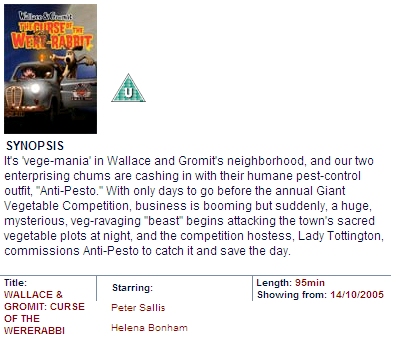
Who is the beast? Why, it's a man of the cloth!
Yes, there's a mysterious 'vege-ravaging' beast rampaging around the UK, and this screen grab from the website of UGC cinemas finally reveals its identity! Look carefully in the bottom left corner and all will be revealed!
11 October 2005
Earthquakes don't kill...
Behind the disturbing images currently on our TVs showing the aftermath of the earthquake in Pakistan lies an equally horrible truth which isn't getting much media attention—that most of the deaths could have been prevented.Earthquake experts have long asserted that earthquakes don't kill, buildings do. And buildings generally don't unless people have messed up.Although this has been a very significant earthquake, massively destructive because of its closeness to the surface of earth's crust, it would not have caused anything like the carnage had buildings been properly built in conformity with the building codes present in most countries. Bad engineering, non-existent quality control, inadequate government regulation and quite probably systemic corruption have led directly to the death of tens of thousands of innocent people, many of them children. Lack of capital may well be an issue, but the Pakistani government has no difficulty finding the money to play nuclear games or engage in pointless military conflict with India.Whilst the international community is rallying to provide much-needed assistance, I hope we're also willing to call a spade a spade, so that something positive can come of this disaster.
1 October 2005
eebahgum's 1st birthday and blogging as a state of mind
Yesterday was eebahgum'’s first birthday. After a gestation period of only a few days the birth was reasonably painless thanks to the '‘new blogger'’ and its great default templates. Since then I'’ve changed little, in part because I'’ve tried to focus on content and structure, but if truth be told, also because I'’ve never bothered learning enough about HTML, CSS or any of the other mandatory acronyms. Let'’s face it, life is short, and my family would rather I spent most of my time talking specifically with them, than more randomly with the blogosphere. At the end of the day, much of my blogging is done, well, at the end of the day, when the rest of the household is asleep.
And it'’s been a colourful year, with the '‘restructuring'’ of my employment and the surprising demotivation which accompanied it, then my running away from home for a while to new country, new home, new job with the resultant rediscovery of self which has come with it.
Now I've never been one to pour my heart out in print, and thank heavens for that, but just writing about the things which interest, annoy or amuse me is a great motivator for me, because it changes the way I look at the world. I find myself always on the lookout for things which I think might be interesting to write about, but also trying looking at issues in a more critical and objective way. It's one thing to have an opinion, but entirely another thing to have to express it in writing, especially to people who donÂ’t know you all that well. And the perpetual challenge is to try to put your point of view in such a way that those who disagree with you from the outset might yet be willing to engage with it in some way.
In fact, the very possibility of writing about some things tends to change the way I observe all things. In a way blogging seems to me as much about a state of mind, a way of looking at the world, as it is about what one actually writes—the journey, if you like, as much as the destination—and that too is something to celebrate.
But the most important thing about the blogosphere is that it's other bloggers and blog readers who have planted, watered and nurtured this garden of possibilities in which I have my patch and so it is to you, above all, that I raise my glass today. Live long and prosper!
And it'’s been a colourful year, with the '‘restructuring'’ of my employment and the surprising demotivation which accompanied it, then my running away from home for a while to new country, new home, new job with the resultant rediscovery of self which has come with it.
Now I've never been one to pour my heart out in print, and thank heavens for that, but just writing about the things which interest, annoy or amuse me is a great motivator for me, because it changes the way I look at the world. I find myself always on the lookout for things which I think might be interesting to write about, but also trying looking at issues in a more critical and objective way. It's one thing to have an opinion, but entirely another thing to have to express it in writing, especially to people who donÂ’t know you all that well. And the perpetual challenge is to try to put your point of view in such a way that those who disagree with you from the outset might yet be willing to engage with it in some way.
In fact, the very possibility of writing about some things tends to change the way I observe all things. In a way blogging seems to me as much about a state of mind, a way of looking at the world, as it is about what one actually writes—the journey, if you like, as much as the destination—and that too is something to celebrate.
But the most important thing about the blogosphere is that it's other bloggers and blog readers who have planted, watered and nurtured this garden of possibilities in which I have my patch and so it is to you, above all, that I raise my glass today. Live long and prosper!
Subscribe to:
Posts (Atom)

